Why a Townhome Can Be a Smart First Home in Dallas-Fort Worth (2026)
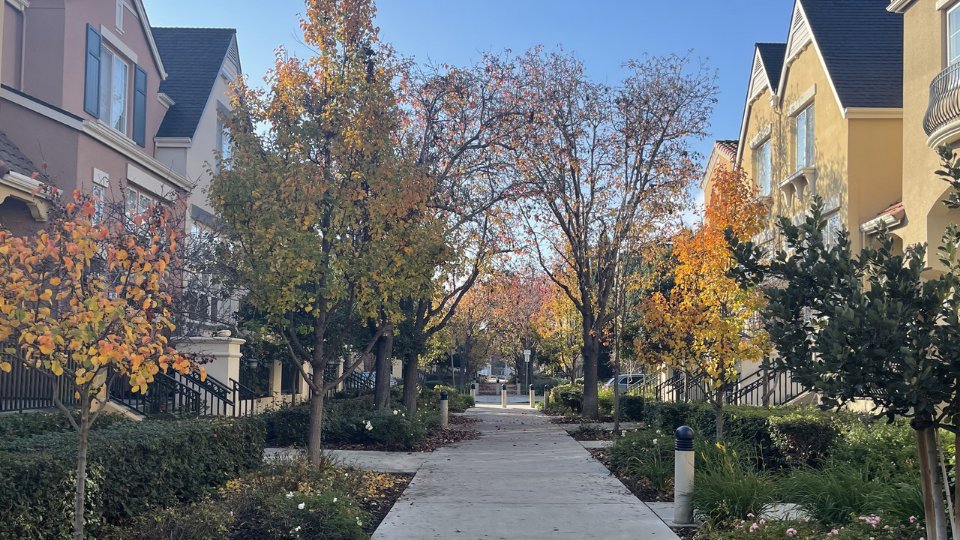
Illustration only: townhomes in the Rivermark community near Agnew Road in Santa Clara, California, photographed December 19, 2021. This is not a Dallas-Fort Worth community. It shows a common townhome layout, with attached homes along a shared walkway. Photo by Usual Nicolaus, via Wikimedia Commons, CC0 public domain dedication, cropped to fit. Original file: Townhomes in the Rivermark Community near Agnew Road.jpg.
A first home in Dallas-Fort Worth does not have to be a detached house on a large lot. For many buyers, especially people leaving an apartment, a townhome is the more realistic first step: you still get a private entrance and, in many cases, a garage or a small patio, without taking on a full yard and a full single-family price.
NewHomeSource recently argued that new townhomes can make strong starter homes, pointing to lower upkeep, a lower price than many detached houses, and the fact that owners often hold title to the unit and the land under it. This November 2026 guide takes the same question and answers it with North Texas numbers: what townhomes actually sold for, how they differ from houses and condos, what HOA dues and Texas property taxes add to the payment, how FHA and conventional financing treat townhomes, and where first-time buyers can look for down payment help.
The short version is that a townhome can be a smart first home in DFW, but it is not automatically the cheaper or easier choice. Location, legal structure, the homeowners association, and the loan type matter as much as the listing photo.
Key Takeaways
- A townhome is not the same thing as a condo. In a typical fee-simple or planned-unit-development townhome, you usually own the structure and the land under it. In a condo, you generally own the interior, and the association owns the building and common areas. Some properties marketed as townhomes are legally condos, which changes insurance, repairs and loan approval.
- Metro-wide, townhomes have been a little less expensive than single-family homes in 2026, but not in every city or every month. The Texas Real Estate Research Center's October 2026 NTREIS report put the Dallas-Fort Worth-Arlington median townhouse at $370,000 from January through October 2026, compared with $390,000 for single-family homes and $255,000 for condos. In October alone, the townhouse median was $384,500, slightly above the $381,000 single-family median.
- Townhomes are taking longer to sell than detached houses. In October 2026, NTREIS showed a median of 83 days on market for townhouses, versus 66 days for single-family homes and 69 days for condos. Townhouses had 5.8 months of inventory, compared with 4.4 months for single-family homes.
- The monthly cost is more than the mortgage. Most DFW townhomes come with HOA dues, and Texas property taxes are a major carrying cost. School districts must provide a $140,000 residence homestead exemption, but you have to apply for it, and special districts can raise the bill.
- Financing is often simpler when the townhome is not a condo. FHA loans typically require 3.5% down. Fannie Mae's HomeReady program allows as little as 3% down for income-eligible buyers. If the home is legally a condominium, FHA generally requires project approval or Single-Unit Approval, and conventional lenders review the project. Many planned-unit-development townhomes do not need that full review.
- Help with the down payment is available for qualifying Texans. The Texas State Affordable Housing Corporation can provide up to 5% of the loan amount toward the down payment or closing costs, through a grant or a second lien, and first-time buyers may also apply for a Mortgage Credit Certificate.
Townhome, House or Condo: Start With What You Actually Own
The word "townhome" describes how a building looks. It does not, by itself, tell you what you are buying.
A townhome, also called a townhouse, is usually a multi-story home that shares one or two walls with the homes beside it. It has its own entrance, and it often includes a garage, a driveway, or a small patio or yard. That is different from a typical condo, where you may enter through a shared hallway and own only the space inside the walls.
The legal paperwork is what matters at closing:
- Fee-simple or planned-unit-development (PUD) townhome. You typically own the unit and the lot underneath it. An HOA usually maintains shared lawns, alleys, gates or amenities, and it may maintain roofs or exteriors, depending on the declaration. In Fannie Mae's Selling Guide, project review is waived for units in new and established PUD projects, with limited exceptions.
- Condominium, even if it looks like a townhome. You typically own the interior of the unit, plus a shared interest in the common elements. The association owns the building and the land. FHA will insure a loan in an FHA-approved project, or in a project that meets Single-Unit Approval rules.
- Single-family house. A detached home on its own lot. Some subdivisions still have HOAs, but you are usually responsible for the yard, roof and exterior.
Ask your agent and your title company to confirm the legal regime before you write an offer, and tell your lender the same day you go under contract. A listing that says "townhome" is not a substitute for the recorded declaration and the appraisal.
| Feature | Typical townhome (fee-simple or PUD) | Single-family house | Condominium |
|---|---|---|---|
| What you usually own | The unit and the land under it | The house and the lot | The interior of the unit, plus a share of common elements |
| Shared walls | One or two walls with neighbors | None, unless it is a duplex marketed separately | Often floors, ceilings or walls, depending on the building |
| Private entrance | Yes, in most cases | Yes | Sometimes; many mid-rise and high-rise buildings use shared hallways |
| Yard or outdoor space | Often a small patio, courtyard or yard | A private yard, size varies | Balcony or patio is common; a private yard is less common |
| Exterior and roof repairs | Varies by HOA declaration; sometimes the association, sometimes the owner | Usually the owner | Usually the association, funded by dues and reserves |
| HOA | Common, and often required | Common in newer subdivisions, not universal | Almost always |
| Loan review of the project | Often treated more like a house if it is a PUD; confirm with the lender | Standard single-family underwriting | FHA project approval or Single-Unit Approval; conventional project review |
Those are typical patterns, not guarantees. The declaration, plat and title commitment for the specific property control.
What DFW Townhomes Actually Cost in 2026
The cleanest metro comparison comes from the October 2026 NTREIS monthly report, prepared by the Texas Real Estate Research Center at Texas A and M University from North Texas MLS listings. The figures include new and existing homes sold through NTREIS. They do not include every builder sale or every sale by a non-member.
Two periods are worth looking at side by side. The year-to-date median is the more stable number. October is the most recent full month in the report, and it shows how quickly a one-month snapshot can move.
| Property type, Dallas-Fort Worth-Arlington metro | January through October 2026 median sale price | Change from the same period a year earlier | October 2026 median sale price | October change from a year earlier | October median days on market | October months of inventory |
|---|---|---|---|---|---|---|
| Townhouse | $370,000 | Down 5% | $384,500 | Up 5% | 83 | 5.8 |
| Single-family house | $390,000 | Down 2% | $381,000 | Down 2% | 66 | 4.4 |
| Condominium | $255,000 | Down 2% | $247,999 | Down 2% | 69 | 9.0 |
Source: Texas Real Estate Research Center, NTREIS Monthly MLS Summary Report, October 2026, released November 7, 2026.
A few details sit behind those medians:
- From January through October 2026, NTREIS recorded 2,234 townhouse sales in the metro, compared with 72,554 single-family sales and 2,029 condo sales. Townhomes are a real part of the market, but they are a much smaller slice than detached houses.
- In October 2026, the typical townhouse sold for $204.72 per square foot, compared with $182.39 for a single-family home and $210.76 for a condo. A lower total price does not always mean a lower price per foot.
- Townhouses sold at 94.4% of list price in October, close to the 93.7% figure for single-family homes. Condos sold at 90.9% of list price.
- At the end of October, NTREIS counted 1,280 active townhouse listings in the metro, versus 31,752 active single-family listings and 1,771 active condo listings.
The year-to-date gap is modest: the typical townhome sold for $20,000 less than the typical single-family home, or about 5% less. That can still be the difference that gets a first-time buyer to a comfortable budget, but it is not a promise that every townhome is a bargain. In October, the metro townhouse median actually came in $3,500 above the single-family median.
If you currently rent, it also helps to know that a townhome is not automatically a cheap rental either. In October 2026, the median NTREIS lease was $2,595 for a townhouse, $2,300 for a single-family house, and $1,800 for a condo.
HOA Dues, What They Cover, and Texas Property Taxes
Homeowners association dues
Most townhome communities in North Texas have a mandatory HOA. Dues vary widely by location, age of the community, and what the association actually maintains. Some associations only handle shared lawns, alleys and a modest reserve account. Others maintain roofs and exteriors, carry a master insurance policy, and run a pool, gates or a clubhouse. Urban or amenity-heavy associations can charge several hundred dollars a month; simpler ones may charge less. There is no official metro average, so treat any rule-of-thumb figure with caution.
Before you rely on the listing's monthly dues, ask for:
- The declaration, bylaws and rules, including any rental cap, pet rules, and parking rules
- The current budget and the reserve study, if one exists
- The resale certificate, which Texas law requires a property owners association to provide
- A record of special assessments and any pending litigation
- A clear maintenance chart: who repairs the roof, siding, fence, foundation and driveway
Under Texas Property Code Chapter 207, a property owners association generally must deliver subdivision information and a resale certificate after a written request. The Texas Real Estate Commission publishes a standard resale certificate form for that purpose. Condominiums have a separate process under Chapter 82. Build time for these documents into your option period.
Healthy dues are not wasted money if they are actually funding reserves and exterior upkeep. Weak reserves, unpaid dues by other owners, or a pattern of special assessments can erase the savings you thought you were getting on the purchase price, and they can scare off the next buyer's lender.
Texas property taxes
Texas has no state property tax and no state personal income tax. Local taxing units levy the property tax, and the combined rate changes by city, school district and any special district. The Texas Comptroller requires school districts to provide a $140,000 general residence homestead exemption. Taxing units may also adopt a local-option homestead exemption of up to 20% of appraised value, with a $5,000 minimum. You usually apply with the appraisal district by May 1. If you buy after January 1, you may still receive a partial-year exemption if you qualify and the previous owner did not already claim the same exemption for that year.
Two labeled examples show how much the address matters. Both use a $370,000 purchase price, which is the January-through-October 2026 NTREIS metro townhouse median. Both assume the home is a homesteaded owner's principal residence, and both leave out mortgage insurance, HOA dues and any MUD, PID or other special district. These are OnDemand estimates, not official tax bills.
Example A: City of Dallas, inside Dallas ISD. Using the Dallas Central Appraisal District's 2026 estimated rates, the combined rate before exemptions is $2.226760 per $100 of value, from Dallas ISD at $0.985735, the City of Dallas at $0.697800, Dallas County at $0.224650, Parkland Hospital at $0.212000, and Dallas College at $0.106575. Dallas ISD has also published that $0.985735 total as its current fiscal-year rate, plus a 10% optional homestead exemption on top of the $140,000 school exemption. The city, county, hospital district and college each offer a 20% local-option homestead exemption. After those standard exemptions, the estimated annual tax is about $5,576, or about $465 a month. Before exemptions, the same combined rate would produce about $8,239 a year.
Example B: City of Frisco, on the Collin County side, with no special district. Using the Collin County Tax Assessor-Collector's 2026 adopted rates, the combined rate before exemptions is $1.677551 per $100, from Frisco ISD at $1.019400, the City of Frisco at $0.425517, Collin County at $0.151414, and Collin College at $0.081220. After the $140,000 school exemption, Frisco's 20% city and college homestead exemptions, and Collin County's 5% homestead exemption, the estimated annual tax is about $4,377, or about $365 a month. Before exemptions, the bill would be about $6,207.
Same purchase price, about $100 a month of difference in the tax escrow, and that is before any municipal utility district or public improvement district. If you are comparing new townhomes on the metro's edge, read our guide to how MUD, FWSD and PID taxes change what you can afford and check the parcel itself, not a community-wide range on a flyer.
How Townhome Financing Works: FHA, Conventional and Project Approval
Townhomes are an eligible property type for FHA-insured mortgages. HUD's FHA myths-and-facts guidance lists townhomes alongside single-family homes, two- to four-unit properties, condos, modular homes and manufactured homes that meet FHA standards. The more important question is whether this townhome is legally a house-like PUD or a condominium.
| Loan path | Typical minimum down payment | Project review, in plain terms | Mortgage insurance | Useful to know |
|---|---|---|---|---|
| FHA, on a non-condo townhome | 3.5% of the lesser of the sale price or appraised value, in most cases | Usually underwritten like a single-family home, not as an FHA condo project; still must meet FHA property standards | FHA charges an upfront mortgage insurance premium and an annual premium. Unlike most conventional private mortgage insurance, FHA annual MIP often lasts a long time when you put little down | FHA can be a fit if your down payment or credit profile is thinner than a conventional lender wants. Lenders add their own credit-score and debt-ratio overlays |
| FHA, on a condo (including a "townhome" that is legally a condo) | Same 3.5% minimum in most cases | The project generally must be on FHA's approved list, or the unit must qualify under Single-Unit Approval. Single-Unit Approval is only for complete projects with at least five units that meet a subset of FHA's financial and occupancy rules | Same FHA MIP structure | If the project is not approved and cannot meet Single-Unit Approval, FHA is not a path, no matter how perfect the unit is |
| Conventional, including Fannie Mae HomeReady | As little as 3% for qualifying buyers. HomeReady is designed for income-eligible borrowers and allows gifts, grants and Community Seconds to fund the down payment, with no minimum personal contribution required | For a PUD townhome, Fannie Mae waives project review in new and established PUD projects, with limited exceptions. Condo-classified units go through conventional project review | Private mortgage insurance is typically required when you put less than 20% down. It can usually be canceled once you reach sufficient equity, subject to the loan terms and federal rules | HomeReady is not only for first-time buyers, but income limits apply. A standard conventional loan may also allow a low down payment; your lender will tell you which program fits |
| VA, for eligible veterans and service members | Often 0% | VA has its own condo-project approval rules when the property is a condo | VA funding fee rules differ from FHA MIP and conventional PMI | If you are eligible, ask about VA early. It can change the cash needed to close |
Two practical points follow from that table.
First, get pre-approved before you shop, and tell the lender you are looking at townhomes. If a property is a condo, the lender should check FHA approval or conventional warrantability before you spend the option period on inspections alone.
Second, do not budget only for principal and interest. As of November 12, 2026, the 30-year fixed rate in the Freddie Mac Primary Mortgage Market Survey averaged 7.11%. On a $370,000 purchase with 3.5% down, that rate would put principal and interest at about $2,402 a month on a $357,050 loan. That illustration does not include property taxes, homeowners insurance, HOA dues or mortgage insurance, and your actual rate will depend on credit, down payment, points and the loan program. A Dallas ISD tax escrow near $465 a month, plus dues and insurance, can add a large amount on top.
If a seller offers to help with the rate, our guide to a seller-paid 2/1 buydown walks through the math.
Pros, Cons and Resale
A townhome is a strong first home for some buyers and a poor fit for others. The honest comparison looks like this.
What often works well for a first-time buyer
- A lower metro-wide median price than a detached house, at least across the first 10 months of 2026, which can shrink the down payment and the loan.
- Less day-to-day exterior work, especially if the HOA maintains the yard, roof or siding.
- A private entrance, and often a garage, that feels closer to a house than a mid-rise condo does.
- In some cases, a location closer to job centers than a same-budget detached house.
- A smaller footprint that can be easier to maintain and, later, to leave when you are ready to move up.
What can catch buyers off guard
- HOA dues, special assessments and rules, including limits on renting, parking or exterior changes.
- Shared walls, which mean less privacy and less control than a detached house.
- A smaller or nonexistent yard. If pets are a priority, confirm the HOA rules in writing.
- Loan friction when the community is a condo, the association's finances are weak, or too many units are non-owner occupied.
- A slower recent market than detached houses: more days on the market and more months of inventory in October 2026.
- A higher price per square foot than the typical DFW house, and, in some cities, a higher median sale price as well.
Resale is the part first-time buyers sometimes skip, because the plan is to stay only a few years. That is exactly why it matters. The next buyer will face the same HOA, the same project-approval questions and the same tax bill. A well-run association and a loan-eligible project widen the buyer pool; thin reserves, litigation or a hard rental cap can shrink it.
Selling costs are also real. Our November 2026 guide to the cost of selling a house in Texas is worth reading before you assume a short hold will build much equity, especially with a small down payment.
Where DFW Has the Most Townhomes
NTREIS does not publish a neighborhood-by-neighborhood townhome ranking in the monthly summary, but it does report townhouse sales and active listings by city. The snapshot below is October 2026 and is limited to cities with at least 10 townhouse sales that month. One month is not a full-year forecast, and active listings are a better clue than a single month of sales for where the inventory is.
| City | October 2026 townhouse sales | October median townhouse sale price | Active townhouse listings, October 2026 | Median days on market | Months of inventory |
|---|---|---|---|---|---|
| Dallas | 31 | $514,500 | 258 | 59 | 7.1 |
| Frisco | 15 | $531,990 | 52 | 75 | 4.6 |
| Allen | 13 | $479,990 | 36 | 88 | 5.0 |
| Plano | 13 | $415,000 | 66 | 77 | 3.7 |
| Fort Worth | 10 | $462,700 | 86 | 41 | 4.5 |
Source: Texas Real Estate Research Center, NTREIS Monthly MLS Summary Report, October 2026, Sales Closed by City, Resi Sale-Townhouse.
A few nearby cities had fewer than 10 October sales but still held a sizable for-sale inventory, which is useful if you are touring on a budget or a commute: Irving had 59 active townhouse listings, Arlington 52, Lewisville 51, Carrollton 48, Grand Prairie 46, and McKinney 32.
Two patterns stand out. The City of Dallas has by far the largest townhome inventory in this data set, but its October median was $514,500, well above the metro townhouse median of $384,500. Closer-in product can cost more, not less, than a detached house in an outer suburb. Several northern suburbs also have a steady inventory, and the October medians in Frisco and Allen were also high. If your goal is a lower payment, compare specific communities and tax rates rather than assuming a townhome in a high-demand suburb will automatically price below a house.
New and existing townhomes both belong in that search. A new unit may come with a builder warranty and modern systems, but the HOA may still be in the developer's control and the reserves may be thin. An existing unit lets you study a longer budget history, at the cost of older systems and any special assessments already in the record. For a wider look at who is building in North Texas, see our favorite 10 home builders in Dallas-Fort Worth. For a broader price and inventory picture, see the DFW housing market update for November 2026.
A First-Time Buyer Checklist, Including Down Payment Help
If you are weighing a townhome as your first home, work through these steps before you waive your option period.
- Get a pre-approval that matches the property type. Tell the lender you are shopping for townhomes. Ask whether each candidate is a PUD, fee-simple townhome, or condo, and which loan programs can be used there.
- Build a full monthly budget. Include principal and interest, property taxes, homeowners insurance, HOA dues, and mortgage insurance. If the community is in a MUD or PID, use the combined rate for that parcel.
- Ask about TSAHC assistance early. The Texas State Affordable Housing Corporation is a nonprofit created by the Texas Legislature. Qualifying buyers, including first-time and repeat buyers, may receive up to 5% of the loan amount for the down payment or closing costs. That help can be a grant that does not have to be repaid, a second lien that is forgiven after three years if you stay in the home, or a deferred repayable second lien due when you sell, refinance or pay off the first mortgage. TSAHC offers this through Homes for Texas Heroes, for eligible educators, first responders, veterans and certain other public-service professions, and Home Sweet Texas, for other qualifying buyers. Income and purchase-price limits apply and change, so confirm the current figures with a participating lender. TSAHC's lender materials also describe a minimum credit score of 620.
- If you are a first-time buyer, ask about a Mortgage Credit Certificate. TSAHC says first-time buyers may also apply for an MCC, a federal tax credit based on mortgage interest. Bond-financed assistance and MCCs generally define a first-time buyer as someone with no ownership interest in a principal residence during the past three years, with exceptions for qualified veterans and homes in targeted areas. Non-bond down payment assistance is not limited to first-time buyers.
- Request the HOA resale certificate and financials immediately. Read the rental policy, reserve study, insurance coverage and any special assessment history. If the HOA cannot produce current documents, that is a warning sign.
- Inspect the unit and the parts the association is supposed to maintain. Shared roof, foundation or drainage problems are community issues, but they can still become your cost through dues or assessments.
- Confirm school assignments and tax entities by address. Do not rely on a marketing map.
- Apply for the homestead exemption after you close, and ask how the first-year tax escrow was calculated. A payment based on the seller's exempt bill can come up short in year two.
- Think about the exit before you buy. If you may need to rent the home later, will the HOA allow it, and will a future buyer still be able to get FHA or conventional financing?
- Use the option period. A townhome can look simple on the surface and still hide a legal or financial issue in the association documents.
TSAHC also notes that typical closing costs often run about 2% to 5% of the purchase price, on top of the down payment. On a $370,000 townhome, that is roughly $7,400 to $18,500 before any assistance or seller credits. Get a loan estimate in writing rather than relying on a percentage.
Frequently Asked Questions
Is a townhome cheaper than a single-family home in DFW right now?
Metro-wide, yes, if you look at the first 10 months of 2026: the NTREIS median townhouse price was $370,000, compared with $390,000 for single-family homes. In October alone, the townhouse median was $384,500, slightly above the single-family median, and in Dallas, Frisco and Allen the October medians were much higher than the metro figure. Compare the specific community, not the headline.
Do I own the land if I buy a townhome?
Often, yes, if the townhome is fee-simple or part of a planned unit development. If it is legally a condominium, you generally own the interior and a share of the common elements, not a separate lot in the same way. The recorded documents, not the marketing label, decide this.
Can I use an FHA loan to buy a townhome?
Yes. If the townhome is not a condo, FHA usually treats it like other one-unit homes, with a typical minimum down payment of 3.5%. If it is a condo, the project generally must be FHA-approved or qualify for Single-Unit Approval. Ask the lender to verify that early in the option period.
How much are HOA fees on a DFW townhome?
There is no official metro average. Dues depend on what the association maintains and what amenities it operates, and they can range from a modest monthly amount to several hundred dollars. Get the current budget, reserve study and resale certificate, and add the dues to your payment worksheet before you write an offer.
Can a first-time buyer get help with the down payment in Texas?
Yes, if you qualify. TSAHC may provide up to 5% of the loan amount for the down payment or closing costs, and first-time buyers may also apply for a Mortgage Credit Certificate. A participating lender has to originate the TSAHC loan, and income, purchase-price and credit rules apply.
Will a townhome be hard to sell later?
Not necessarily, but recent NTREIS data show townhouses have been taking longer to sell than detached houses, with 83 median days on market and 5.8 months of inventory in October 2026. Resale is easier when the HOA is financially healthy and future buyers can finance the property with FHA or conventional loans. It is harder when reserves are thin, litigation is pending, or rental rules scare off the next lender.
Related Reading from OnDemand Realty
- How Much Does It Really Cost to Sell a House in Texas? November 2026 Guide
- Seller-Paid 2/1 Buydown: Worth It? Pros, Cons and Math
- DFW Housing Market Update November 2026: Prices, Inventory, and What It Means for You
- Harvest vs Canyon Falls 2026: How MUD, FWSD and PID Taxes Change What You Can Afford
- Our Favorite 10 Home Builders in Dallas-Fort Worth (2026)
Talk Through a Townhome Purchase with OnDemand Realty
If you are trying to decide whether a townhome is the right first home, the useful work is specific: the legal structure of the community, the HOA's books, the tax entities on the parcel, and a loan program that will actually fund. The OnDemand Realty team helps buyers across Dallas-Fort Worth compare those details and walk the next step with clear numbers. Visit www.ondemanddfw.com to get started and connect with our team.
Disclaimer: This article is for general information only and is not legal, tax, lending or financial advice. Market figures come from the NTREIS October 2026 report prepared by the Texas Real Estate Research Center and can be revised. Tax examples are OnDemand estimates using 2026 rates and standard homestead exemptions only; they are not official bills and will not match every address. Loan figures are illustrative, use the Freddie Mac survey rate for the week of November 12, 2026, and are not quotes. Program rules for FHA, Fannie Mae, VA and TSAHC change, and lenders set additional requirements. Confirm every figure with the appraisal district, a participating lender, and a licensed tax or legal professional before you make a decision. OnDemand Realty supports fair housing and equal housing opportunity.
Categories
Recent Posts